
Email: [email protected] Phone: (+86) 134 1323 8643
Application of In-Process Probe Measurement in Automotive Wheel Hub Machining
The customer is a large aluminum alloy wheel manufacturer in China, with nearly twenty years of production experience. The company focuses on wheels for passenger cars, commercial vehicles, and premium motorcycles.

Table of Contents
I. Client Profile
The customer is a large aluminum alloy wheel manufacturer in China, with nearly twenty years of production experience. The company focuses on wheels for passenger cars, commercial vehicles, and premium motorcycles.
They are a long-term supplier to several joint-venture OEMs, including Volkswagen, Toyota, and Honda. Annual output is about four million wheels, exported to more than thirty countries. In the domestic mid- to high-end wheel market, the company remains among the top suppliers.
Because most of their business comes from OEM programs, the customer follows strict automotive quality standards. For wheel machining, they place strong emphasis on dimensional accuracy, batch consistency, and stable production output.
II. Background
In recent years, the automotive industry has moved toward lighter structures, tighter tolerances, and higher safety standards. As a result, OEMs now require much stricter control of key wheel dimensions such as concentricity, axial runout, and bore diameter. For some models, tolerances have been reduced to within ±0.05 mm.
At the same time, market demand has become more fragmented. Wheel models are updated more frequently, and production often shifts between different types in short cycles. The customer must maintain flexibility while keeping overall throughput at a high level.
Under the original production mode, two problems became increasingly clear. First, gravity-cast aluminum blanks showed large variation in machining allowance, typically between 0.3 and 0.8 mm. This was caused by mold wear and uneven cooling. Manual alignment could not compensate for these variations in a stable way.
Second, dimensional inspection relied mainly on offline CMM measurement. Each part had to be removed from the machine and taken to a separate inspection room. A single check required more than fifteen minutes and was limited to sampling only. Full-batch quality could not be monitored, and deviations were often discovered too late.
To close the gap between machining and inspection, the customer decided to introduce in-process measurement and build a closed-loop system linking machining, measurement, and compensation.
III. Key Challenges
1. High scrap caused by inaccurate positioning
Blanks were aligned manually using dial indicators. The result depended heavily on the operator’s experience. Each setup required about five minutes, yet positioning accuracy could only reach ±0.1 mm. This was not enough to offset the uneven machining allowance of the cast blanks.
On average, more than 300 blanks per month were scrapped due to insufficient material or out-of-tolerance dimensions. With a unit blank cost of RMB 150, the annual loss exceeded RMB 540,000.
2. Delayed feedback from offline inspection
Only about five percent of each batch was inspected. This made it impossible to detect changes caused by spindle thermal drift, tool wear, or blank deviation in real time.
In one case, spindle heating caused concentricity errors greater than 0.1 mm across a batch of more than 1,000 wheels. The problem was discovered only after all parts had been completed. Direct losses exceeded RMB 150,000, and delivery schedules to the OEM were affected.
3. Poor consistency during frequent model changes
The customer switches between more than twenty wheel models every month. Each change required new setup and parameter adjustment, taking two to three hours.
Because different operators adjusted the machines differently, key dimensions varied between batches of the same model. OEM complaint rates reached three percent, creating pressure on quality management.
IV. Solution
Qidu Metrology worked with the customer to develop a solution based on their ten VMC850 vertical machining centers. The system combines the DOP40 cnc touch probe with dedicated measurement software.
The goal was to create a process where measurement is carried out directly on the machine and used immediately for compensation.
1. Fixture positioning compensation
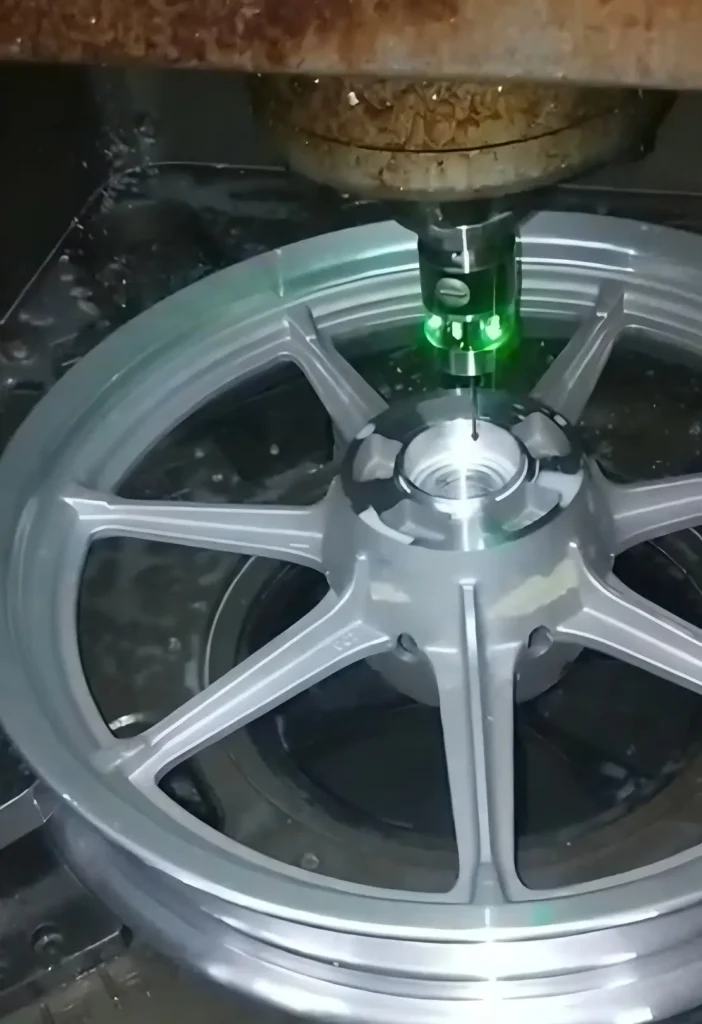
After the blank is clamped, the CNC automatically starts the cnc probe cycle. The touch probe measures four evenly distributed points inside the center bore. Five reference points are then measured on the mounting face to evaluate flatness and height deviation.
The software calculates the real workpiece position and compares it with the programmed coordinates. Compensation values for the X, Y, and Z axes are generated and sent directly to the CNC control.
With this method, positioning accuracy is kept within ±0.02 mm, without manual adjustment.
2. In-process dimension monitoring
For high-value wheel models, an additional check is performed between rough machining and finishing. The cnc probe measures critical dimensions such as bore diameter and step height.
If any value exceeds the preset tolerance of ±0.03 mm, the system stops the process and issues an alarm. Tool wear compensation is suggested before machining continues, preventing large batches of defective parts.
3. Fast changeover between models
A model database stores probing points, compensation rules, and tolerance limits for each wheel type. When production changes, the operator simply selects the corresponding program.
No manual re-debugging is required. Changeover time is reduced from two to three hours to less than fifteen minutes.
V. Results
After the DOP40 cnc probe was put into operation, the customer achieved measurable improvements.
- Concentricity improved from 0.1 mm to 0.04 mm
- Axial runout is now controlled within ±0.03 mm
- First-pass yield increased from 96.5% to 99.8%
- Dimensional variation between batches was reduced by 60%
- OEM complaint rate fell below 0.2%
Setup time per machine was reduced from five minutes to under forty-five seconds. Output per shift increased by 22%. Model change efficiency improved by 87.5%, and overall capacity utilization rose to 95%.
The scrap rate dropped from 0.75% to 0.1%, saving more than RMB 540,000 per year. Offline inspection workload was reduced by 70%. Because cutting compensation is now more uniform, tool life increased by about 20%.
VI. Customer Comment
“Qidu’s probing system helped us solve long-term problems between precision control and production efficiency. Automated positioning has reduced our dependence on manual skills, and dimensional stability has improved significantly. Their technical support team responded quickly and provided solutions tailored to our process. We see them as a long-term partner.” — Production Technology Director

 English
 العربية
 Español
 Русский
 Français
 Deutsch (Sie)
 Português
 Italiano
 日本語
日本語 한국어
한국어